
Texture, Space & Spectacle - Photographer Captures Unique Perspectives of Sagrada Família

By Derry Ainsworth Categories: Architecture Photography, Creative Composition, Travel Journal | Barcelona, Spain
To photograph Antoni Gaudí’s Basílica de la Sagrada Família is to engage in a dynamic dialogue with form, texture, space, and spectacle. Arriving in Barcelona in June 2026, my creative mission was to move entirely past predictable tourist angles and document this historic space through an architectural lens focused on unique angles, human experience and textures.
In 2026, the basilica offers an unprecedented visual spectacle. With the recent structural milestones of the towering central pinnacles - culminating in the glowing morning star atop the Tower of the Virgin Mary and the final ascents of the Tower of Jesus Christ - the exterior profile of the church stands closer to completion than at any other point in history. For a photographer mapping out a city's architectural identity, this year provides a perfect sweet spot to isolate clean geometric planes, unencumbered by the sprawling scaffolding that once dominated the skyline.

The Climax of the Trip: A Rare Celestial Alignment
Of all the frames captured during my time in Barcelona, one stands out as the definitive shot of the trip. On the night of 17 June 2026, a spectacular, highly fleeting celestial event unfolded in the skies directly over Catalonia: a razor-thin crescent moon paired in ultra-close conjunction with a brilliant, gleaming Venus.
Compositional Breakdown: Cosmic Alignment
Capturing this image required hours of meticulous spatial planning, tracking orbital paths, and waiting in absolute stillness for the geometry of the planets to match the geometry of Gaudí.
This is an exceptionally rare angle of the Sagrada Família for several structural and environmental reasons:
The Completed Silhouette: Night photography in 2026 showcases the basilica's newly integrated lighting scheme in its full glory, illuminating the massive crowning cross and the brilliantly lit star of the Virgin Mary.
Astrological Precision: The window of time to catch both the crescent moon and Venus hanging perfectly in the narrow negative space between the central towers and the Nativity spires lasted only a matter of minutes before orbital rotation carried them out of frame.
The Earthshine Effect: Because the moon was a slender crescent, the image beautifully displays "earthshine" - where light reflecting off Earth faintly illuminates the dark, unlit portion of the lunar disk, giving the moon a complete, ghostly spherical presence next to the piercing point-light of Venus.
Natural Framing: By pushing back into the surrounding street foliage, the dark leaves create an organic, silhouetted frame that keeps the entire focus locked onto the glowing masonry and the brilliant cosmic alignment above.

Bending the Frame: Biomimetic Geometry and Architectural Volume
Gaudí’s design language was a direct rebellion against the cold, clinical straight lines of traditional European engineering. Believing that nature was the ultimate draftsman, his variant of Catalan Modernism integrated organic engineering directly into stone. To translate this into high-impact photography, your compositions must mirror his spatial philosophies - looking for fluid weight distribution, deep dimensional layers, and natural forms.
Compositional Breakdown: The Kinetic Spectacle
To capture the pure drama of the Passion Facade, I avoided an eye-level static shot. Instead, I timed an intentional long exposure right at the baseline of the entrance. The sea of passing crowds blurs into a sweeping, ghostly wave of movement, juxtaposed against the massive, bone-like stone pillars rising firmly into a rich blue sky. This wide perspective uses the chaotic human spectacle to emphasize the frozen, permanent grandeur of the cathedral above.

Isolations of Form: Abstracting Textures Against the Sky
When you lift your lens to the highest peaks of the Sagrada Família, you begin to see the incredible micro-textures that make up the macroscopic monument. The spires aren't uniform blocks; they are treated with intricate diamond perforations, jagged triangular stone vents, and highly reflective glazed tile mosaics.
Compositional Breakdown: Geometric Zenith
In this image, I chose to isolate the pinnacle of the Tower of the Virgin Mary using a telephoto compression. By filling the frame with a steep, upward angle and dropping out the horizon, the tower turns into an abstract study of repeating serrated lines and coarse stone work. The twelve-pointed glass morning star crowns the image, popping sharply against a flat, minimalist cyan sky.

Contextual Space: Unconventional Street Reflections
The sheer volume of the basilica can be felt blocks away. It acts as an anchor for the surrounding urban grid, casting a presence over everyday life. To document its spatial relationship with Barcelona, I looked for hidden vantage points and unexpected framings.
Compositional Breakdown: The Fragmented Vista
In the image above, I framed the sunlit spires in the deep background, utilizing dark silhouetted trees and street architecture in the foreground to create distinct layers of depth. The result is a cinematic street vignette that places the grand monument behind the humble grit of a local pushing a cart through the avenue.
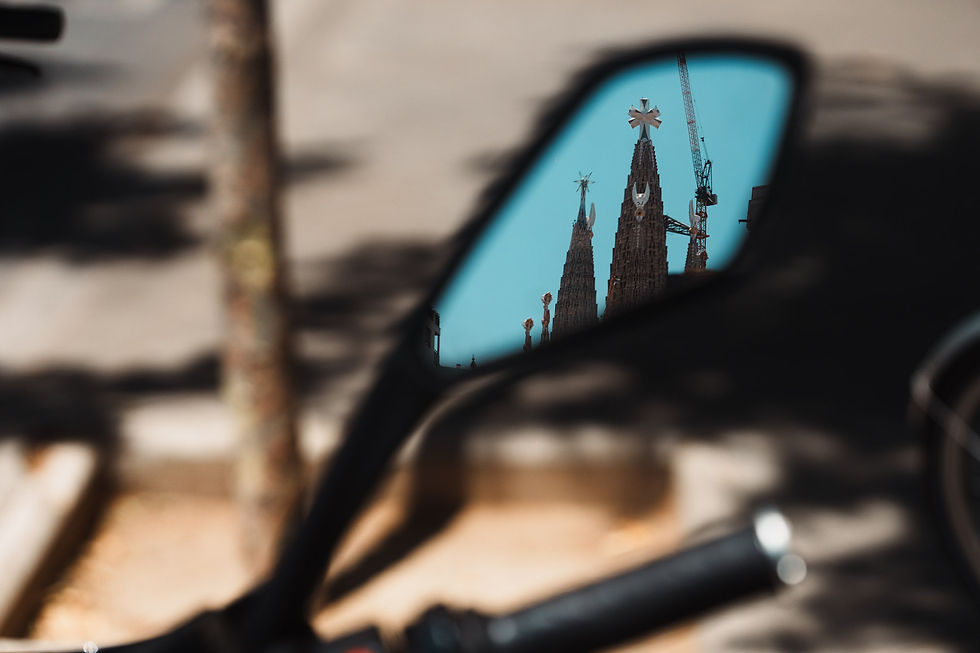
Taking spatial experimentation further, this image above isolates the spires completely inside a motorcycle’s rearview mirror. By pulling a tight focus onto the glass surface and allowing the physical street to blur into soft bokeh, the image turns a casual city object into a beautiful frame within a frame.
The Interior Symphony: Sculpting with Light and Volume
Stepping inside the central nave forces you to rethink how your lens handles space and volume. The interior acts less like a traditional church and more like a massive, sunlit clearing in an ancient wood.

Compositional Breakdown: - The Symmetrical Canopy
Looking vertically toward the ceiling, this image captures the ultimate architectural symmetry. The branching stone columns extend like tree boughs to support a geometric ceiling grid dotted with starlike light vents. This wide-angle, symmetrical perspective perfectly maps out the color spectrum of the interior—bleeding from deep, fiery amber glass on the left side to calm, deep blues on the right.
The Symmetrical Canopy a single figure is isolated in a pool of golden evening light cast from the high western windows, ca I turned the camera toward an isolated architectural curve - a glowing, winding stone spiral stairc
Compositional Breakdown: Human Element & Deep Shadows
To capture the real scale of this vast internal volume, my final series inside the basilica focused heavily on high-contrast silhouettes and single point sources of light:
In the first image above, the glowing altar baldachin and hanging crucifix are observed through a deep, silhouetted frame of onlookers, creating a moody layer of human contemplation.
In the second image above, a single figure is isolated in a pool of golden evening light cast from the high western windows, capturing a moment of absolute awe inside the stone forest.
In the third image above, I turned the camera toward an isolated architectural curve - a glowing, winding stone spiral staircase emerging from heavy shadows. This angle highlights the rough texture of the masonry while pulling the viewer's eye into a hidden mystery of the structure.
Final Thoughts: Sagrada Familia - A Complete Visual Journey
Documenting the Sagrada Família in 2026 was a masterclass in spatial patience. By utilizing alternative angles ranging from long exposures and tight telephoto isolates to mirrored street frames and wide vertical abstracts, my goal was to dismantle the predictable, traditional view of this iconic monument. Gaudí didn’t simply design a static building; he cultivated a texturized, light-bending ecosystem where advanced human engineering and natural splendor exist as a singular, living entity.
Photographing a structure of this scale introduces a unique creative challenge. Because the architecture is so profoundly impressive, the sheer volume of details can easily become overwhelming, making it difficult to isolate singular, disciplined compositions. Every square inch of stone demands attention, forcing you to constantly slow down and think critically about your frame.
The process of moving across Barcelona to track down these distinct, unconventional viewpoints became one of the most fulfilling aspects of the trip. Hunting for lines of sight through shifting streetscapes eventually led to the ultimate reward: aligning the clean, modern profile of the spires with the rare celestial conjunction of the crescent moon and Venus. It was a moment of pure photographic serendipity that perfectly summarized the intersection of earthly geometry and cosmic scale.
For any photographers or travelers planning their own pilgrimage to this masterpiece, a word of practical advice: do not leave your logistics to the last minute. To experience the awe of the interior forest, you need to book your tickets months in advance. Having missed the initial booking window, I had to pay a premium for a resale ticket just to get through the doors. But it was definitely worth it.
Ultimately, shooting Gaudí’s crowning achievement was a deeply inspiring and creatively rejuvenating experience. It pushes the boundaries of how we perceive three-dimensional space, and I highly recommend that every photographer challenge themselves to view, deconstruct, and capture it through their own unique lens.
Sagrada Familia - Gallery by Derry Ainsworth
Sagrada Família, June 2026, Barcelona Spain, by Derry Ainsworth Sagrada Família, June 2026, Barcelona Spain, by Derry Ainsworth Sagrada Família, June 2026, Barcelona Spain, by Derry Ainsworth Sagrada Família, June 2026, Barcelona Spain, by Derry Ainsworth Sagrada Família, June 2026, Barcelona Spain, by Derry Ainsworth Sagrada Família, June 2026, Barcelona Spain, by Derry Ainsworth Sagrada Família, June 2026, Barcelona Spain, by Derry Ainsworth Sagrada Família, June 2026, Barcelona Spain, by Derry Ainsworth Sagrada Família, June 2026, Barcelona Spain, by Derry Ainsworth Sagrada Família, June 2026, Barcelona Spain, by Derry Ainsworth Sagrada Família, June 2026, Barcelona Spain, by Derry Ainsworth Sagrada Família, June 2026, Barcelona Spain, by Derry Ainsworth Sagrada Família, June 2026, Barcelona Spain, by Derry Ainsworth Sagrada Família, June 2026, Barcelona Spain, by Derry Ainsworth Sagrada Família, June 2026, Barcelona Spain, by Derry Ainsworth Sagrada Família, June 2026, Barcelona Spain, by Derry Ainsworth Sagrada Família, June 2026, Barcelona Spain, by Derry Ainsworth Sagrada Família, June 2026, Barcelona Spain, by Derry Ainsworth Sagrada Família, June 2026, Barcelona Spain, by Derry Ainsworth Sagrada Família, June 2026, Barcelona Spain, by Derry Ainsworth Sagrada Família, June 2026, Barcelona Spain, by Derry Ainsworth Sagrada Família, June 2026, Barcelona Spain, by Derry Ainsworth Sagrada Família, June 2026, Barcelona Spain, by Derry Ainsworth Sagrada Família, June 2026, Barcelona Spain, by Derry Ainsworth Sagrada Família, June 2026, Barcelona Spain, by Derry Ainsworth Sagrada Família, June 2026, Barcelona Spain, by Derry Ainsworth Sagrada Família, June 2026, Barcelona Spain, by Derry Ainsworth Sagrada Família, June 2026, Barcelona Spain, by Derry Ainsworth Sagrada Família, June 2026, Barcelona Spain, by Derry Ainsworth Sagrada Família, June 2026, Barcelona Spain, by Derry Ainsworth Sagrada Família, June 2026, Barcelona Spain, by Derry Ainsworth Sagrada Família, June 2026, Barcelona Spain, by Derry Ainsworth Sagrada Família, June 2026, Barcelona Spain, by Derry Ainsworth Sagrada Família, June 2026, Barcelona Spain, by Derry Ainsworth Sagrada Família, June 2026, Barcelona Spain, by Derry Ainsworth Sagrada Família, June 2026, Barcelona Spain, by Derry Ainsworth Sagrada Família, June 2026, Barcelona Spain, by Derry Ainsworth Sagrada Família, June 2026, Barcelona Spain, by Derry Ainsworth Sagrada Família, June 2026, Barcelona Spain, by Derry Ainsworth Sagrada Família, June 2026, Barcelona Spain, by Derry Ainsworth Sagrada Família, June 2026, Barcelona Spain, by Derry Ainsworth Sagrada Família, June 2026, Barcelona Spain, by Derry Ainsworth Sagrada Família, June 2026, Barcelona Spain, by Derry Ainsworth Sagrada Família, June 2026, Barcelona Spain, by Derry Ainsworth Sagrada Família, June 2026, Barcelona Spain, by Derry Ainsworth Sagrada Família, June 2026, Barcelona Spain, by Derry Ainsworth Sagrada Família, June 2026, Barcelona Spain, by Derry Ainsworth

Comments